You already know the sound. The gasp before the scream — and every eye in the room turning to you before your toddler even finishes inhaling.
You're at your sister's wedding, or church, or just the market for tomatoes, and it happens again. The stiffening body. The scream that seems to come from nowhere and everywhere at once.
You bend down, you bribe, you beg, you raise your voice a little more than you meant to. Nothing works fast enough. You kneel there, smiling with your mouth and dying with your eyes.
You Google it quietly, after midnight, so no one sees the search history. "Why does my toddler scream in public." "Am I a bad mother."
By the time you're bribing, negotiating, or raising your voice, it's already too late.
Every tantrum tactic you've tried — the sweets, the toys, the stern warning — is a reaction. You're trying to control a storm that's already made landfall. A two-year-old mid-meltdown has almost no capacity to reason or "calm down" on command. Their brain, at that moment, is not listening to you. It's flooded.
The mothers who seem to have "easy" toddlers in public aren't lucky. Almost always, something happened before they ever left the house — an expectation was set, a routine was run, a small ritual prepared the child's mind for what was coming.
That's the piece nobody hands you in the hospital, or the family WhatsApp group, or the parenting blogs written for a completely different culture. The fix isn't a better reaction. It's a different starting point — one that happens at your own front door, before the world ever sees your child at all.
I used to yell. I bribed with everything I could grab. I apologized with my eyes to strangers.
My name is Jay. I'm a Nigerian wife and mother who runs a bakery startup and loves to garden in broken buckets. Some days it feels like I'm holding two jobs and a toddler together with tape and prayer. I am not a childhood development expert. I'm not a doctor. I'm a mother who lived exactly what you're living now, for longer than I want to admit.
It started small. My daughter was over seventeen months old, and the first "episode" happened on my way home from a simple errand. She wanted something — I don't even remember what anymore — and when she didn't get it fast enough, she went rigid and screamed loud enough that conversation actually stopped. I remember the silence more than the scream. I remember how the elderly women around looked at me like I was unfit to be a mum.
I laughed it off that day. "Ah, toddlers now." Everyone nodded politely. But something in me had already curled up in shame.
It kept happening. Church, most Sundays. The market. Almost every trip back home from crèche.
I tried everything I could think of.
Bribing
Sweets in my bag, promises of toys. It worked sometimes, in the moment — but I was teaching her that a big enough scene got her what she wanted. I was training the exact behavior I was trying to stop.
Yelling
There were days I lost my composure completely — hissing through my teeth in public, using a tone I never wanted to use with my own child. I hated who I became. I'd apologize to her afterward, half-crying myself.
Avoidance
If outings caused this much stress, I would simply stop going out. It didn't fix anything — it just shrank my world and made me more isolated and exhausted.
The blogs
"Get down to their eye level. Stay calm." Good advice, in theory. None of it accounted for the aunty standing right there sucking her teeth while my toddler screamed at a wedding.
Prayer and hoping it was a phase
I told myself she'd grow out of it. Some days I just endured, counted down the minutes, and hoped the next outing would somehow be different.
The turning point wasn't dramatic. It was exhaustion, plain and simple. After one particularly brutal outing, I sat in my sitting room and asked myself a different question: not "how do I stop THIS tantrum" but "what would have to be true BEFORE we even left the house for this not to happen at all?"
I started small and low-stakes — inside our own compound, not the gate, not the street. I would kneel down, look my daughter in the eye, and tell her, simply and calmly, what I expected. One rule, said the same way, every single time. Then just outside the gate. Then, slowly, on real outings.
Within about ten days of doing this consistently, something shifted. Not perfection. A real, noticeable change. And something in me changed too — I stopped walking into outings already braced for disaster.
I am not telling you this will make your toddler perfect. I am telling you it made mine noticeably, measurably calmer in public — and it made me feel, for the first time in a long time, like a mother in control of her own home.
The honest, real timeline
This reflects Jay's own real experience — not a guarantee, since every toddler is different.
- Day 1
First doorstep ritual, done inside the compound only. Toddler is curious, mildly resistant. No outing attempted.
- Day 2–3
Ritual repeated daily in the compound. Toddler begins recognizing the pattern.
- Day 4–5
First test just outside the gate, for a short errand. Mild resistance, but noticeably calmer than before.
- Day 6–7
Ritual becomes familiar. Toddler starts participating rather than resisting.
- Day 8–10
First real outing using the full ritual. Noticeable reduction in meltdown intensity and frequency.
- Day 10+
Ritual becomes second nature for both of you. Not every outing is perfect — but the pattern of dread and public shame is fundamentally broken. Most toddlers will be reciting the rules alongside you by now.
Before you decide
What if my toddler is different — more stubborn, more sensitive, younger or older than yours?
What if it doesn't work right away?
Is this just another generic parenting guide?
Do I need to buy anything special to start?
My toddler is in creche/daycare most of the day — will this still work?
What if I actually use it and it genuinely doesn't help?
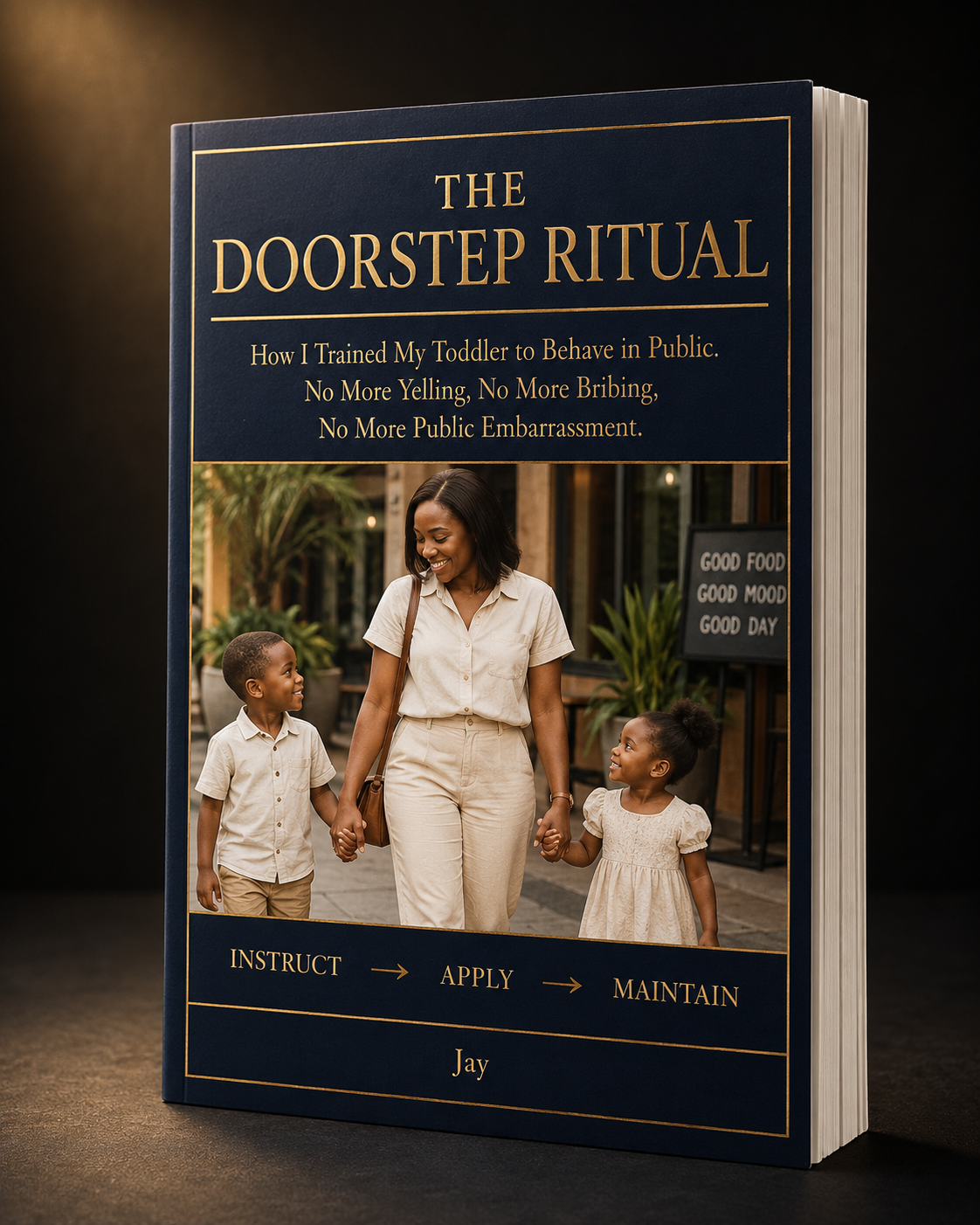
The Doorstep Ritual
The exact system I built and use, every single day, before we ever step outside.
Two printable tools, included
Bonus 1: The Doorstep Ritual Wall Card (Printable)
Never forget the five rules again. Print this A4 wall poster and place it beside your front door so the ritual becomes part of your family's daily routine — a simple visual reminder for your toddler, right where you both need it most.
Bonus 2: 30-Day Doorstep Ritual Progress Tracker (Printable)
Reading the guide is one thing — using it consistently is what creates lasting change. This printable 30-day tracker helps you stay accountable as you build the ritual into your daily routine. Record each outing, track your consistency, note your child's responses, identify tantrum triggers, and watch your progress unfold over time. Because the goal isn't perfection — it's progress you can actually measure.

Your price today
₦9,800
Get Instant Access →Bonus 1 and Bonus 2 are included free for the first 10 days only. After that, the price returns to ₦16,000.
My 21-Day Peace-of-Mind Guarantee
I believe in The Doorstep Ritual because it's the exact system I use with my own daughter. That's why you can try it completely risk-free.
Read the guide, follow the ritual consistently for 10 consecutive days, and give it an honest chance. If, after those 10 days, you genuinely feel it hasn't helped you feel more prepared, more confident, or more in control before outings, simply send me an email within 21 days of your purchase and I'll refund your money — no interrogations, no lengthy forms, no hard feelings.
The only thing I ask is that you give the system an honest, consistent try before deciding it isn't for you. When you write in, just tell me briefly how your 10 days went — this isn't about proving anything, it just helps me know the ritual was genuinely tried, so I can keep offering this guarantee to mothers who really need it.
Because this isn't about promising a perfect child. It's about giving you a practical, repeatable system that helps you step out of your home with more confidence than you had yesterday.
P.S. — You don't need hours of free time to use this system. The Doorstep Ritual takes less than 10 minutes before you leave the house, but it can completely change how you approach every outing. Try it risk-free with the 21-day guarantee.
P.P.S. — Bonus 1 (Wall Card) and Bonus 2 (30-Day Progress Tracker) are included free for the first 10 days only. After that, they become paid add-ons and the total returns to ₦16,000 instead of today's ₦9,800.
P.P.P.S. — You are not a bad mother. You are a tired one, doing your best with no map. This is the map I wish someone had handed me at the door, months before I finally built it myself.